

At a glance
- Problem: Sigma Education already ran a manual matchmaking service between students and tutors. They wanted an automated version of that service on their website, without replacing the site or the booking system they already used.
- What I did: Built a matching form into the existing site. It applied the founder's matching method, returned a ranked shortlist with tutor profiles, booked through their existing tutor system, and sent confirmation emails.
- What changed: Students could complete the match-and-book path online. The office no longer had to chase confirmation emails after each successful booking.
- When: Delivered December 2020. The original site is no longer online.
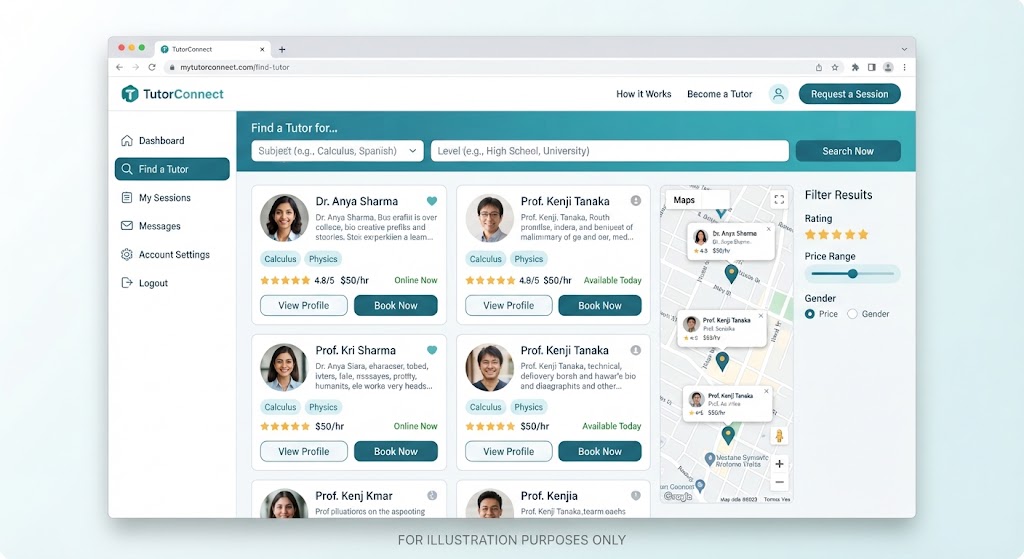
The original website and matching application are no longer publicly available. The linked interactive demo is a sanitised recreation of the student workflow: fictional tutors and data, illustrative matching only (not the original proprietary algorithm), and mock email previews with no messages sent.
The problem
Sigma Education Services was a private tutoring business for the HSC, the New South Wales senior school certificate. Matching students with suitable tutors was already part of how they worked. That matching was done manually.
They wanted to put an automated version of that service on their website: a student fills in what they need, sees a shortlist of suitable tutors, and can book, without the office running every match by hand.
The public website was already on Wix. Tutors, profiles, and the calendar lived in TutorCruncher, the booking product the business already paid for. Replacing either one, just to automate matching, would have been a larger project than was needed.
Internally they described it as "Uber for Tutoring". That was a shorthand for match, then book. It wasn't a claim that the product worked like a rideshare app.
Two limits shaped the build. The founder's matching method had to stay private, so it couldn't sit in the public page where anyone could read it. And tutor records couldn't be copied into a second list that would drift out of date.
The approach
Students stayed on the existing website. They filled in a form there. The matching itself ran on a private program I hosted separately, using the founder's method, the same kind of judgement the manual service relied on, and the results came back as a ranked list. Booking stayed in TutorCruncher. After a booking was confirmed, confirmation emails went to the student, the tutor, and Sigma's office.
Students saw one form. The business kept its website and its booking system.
How it worked
The form and results sat inside the existing website, so students didn't leave the domain. Submitted answers went to a private matching program that scored and ranked tutors. The matching method stayed confidential and isn't described here.
Tutor profiles and booking stayed in the system Sigma already used. Once a booking was confirmed, emails went out to the student, the tutor, and the office.
The outcome
By December 2020, Sigma had an online path that automated the matchmaking service they already offered. A student could submit what they needed, see a ranked shortlist, book through the system the business already used, and get a confirmation without staff sending it by hand.
The original site is no longer public. A sanitised interactive demo of that workflow is linked above. I don't have booking numbers or conversion figures from the engagement.
Need matching or booking on systems you already use?
If you already match people or bookings by hand and want that process on your website without replacing the systems behind it, get in touch.