

At a glance
- Problem: PCCS had to send anonymised clinical data to the national Primary Mental Health Care Information System (PHMCIS) for compliance. The only commercial path quoted was about $40K AUD, plus $5K a year to maintain. Staff spent about 20 to 60 minutes a week compiling and uploading data by hand. When someone forgot, funders chased missing quarters.
- What I did: Built a background sync from Salesforce into the PHMCIS API. I worked with the technology director who oversees that system to get the endpoint docs, business rules, and minimum data set.
- What changed: They avoided the quoted vendor build and annual fee. The weekly manual upload stopped. Reporting no longer depended on someone remembering to send the file.
- When: Delivered April 2026.
Confidentiality note: Some details in this case study have been generalised or anonymised. I was not given explicit permission to publish the full specifics of this project.
The problem
Primary and Community Care Services (PCCS) needed to upload anonymised clinical data to the PHMCIS to meet funding and reporting requirements. Only one other organisation offered a case management product with a direct PHMCIS link. That same organisation quoted roughly $40K AUD for consulting and development, plus about $5K AUD a year to maintain an integration. The options were to connect from the Salesforce app PCCS already used, or move PCCS onto their platform that already talked to PHMCIS.
PCCS found that alternative system mediocre and preferred to stay on Salesforce. So staff kept extracting data from Salesforce, cleaning it, and uploading it into the other system or the PHMCIS portal by hand. The weekly effort was not huge. It was often twenty minutes, sometimes up to an hour when there was more data or errors to fix. But it was easy to miss. Primary Health Networks (PHNs) would chase PCCS when quarters were incomplete. At one point, several months of data had simply not been sent because it slipped someone's mind.
A $40K quote plus ongoing maintenance was hard to justify for that amount of admin. Forgetting still carried a real compliance risk.
The approach
PHMCIS already had a REST API endpoint. It had not been developed or improved much since it was built, so the documentation was brief. I worked with the technology director who oversees the system. They shared business-logic documentation, the data schema, and short code samples with example inputs and outputs for the main HTTPS methods.
That covered the basics I needed: how to authenticate, which data types were accepted, and how to create or update records. I also used the PHMCIS minimum data set (MDS) where Salesforce field names did not line up cleanly with PHMCIS, so the mapping still matched the business rules.
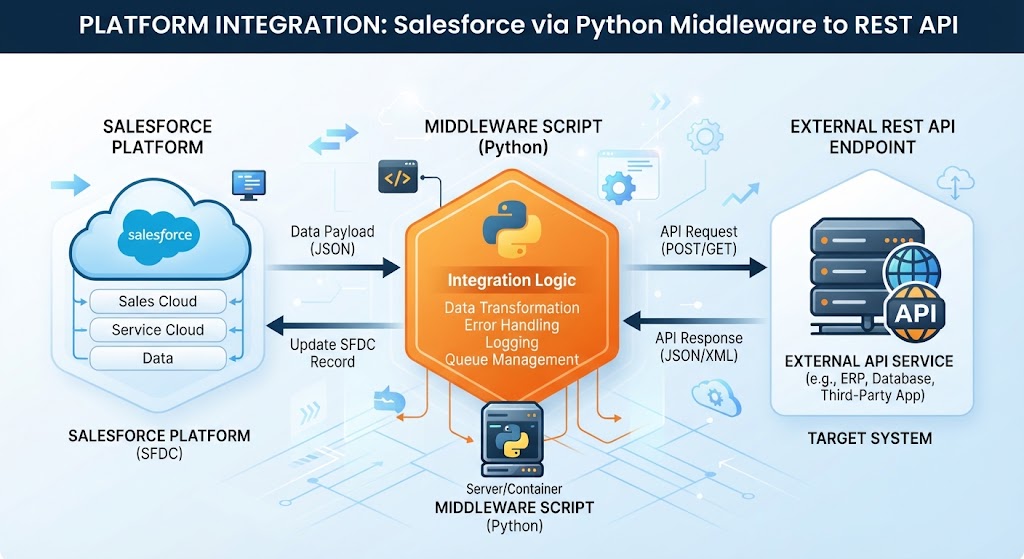
Rather than pay for the vendor path or switch case management systems, I built a small custom middleware script in Python to transform the data and send it directly.
How it worked
I first confirmed I could extract the needed records from Salesforce over its REST API using SOQL, and export them as CSV for testing. Python then cleaned and converted each batch to meet the PHMCIS schema and validation rules. Where a field in Salesforce was named differently, the business logic and MDS filled the gap.
The sync runs in the background. About once an hour it checks Salesforce for changes. When there are any, it builds a payload that matches the endpoint requirements, tries to update existing records first, and only creates a new record when the update fails because that record does not exist yet. That avoids duplicates.
Hourly sync: extract from Salesforce, transform in Python, then update or create records in PHMCIS
This was built on Salesforce because that's what PCCS already used for client records. I work with Salesforce when it fits. It isn't my main focus.
The outcome
PCCS kept the case management system they preferred, avoided the quoted integration path, and stopped relying on a manual weekly upload for mandatory reporting.
Compliance reporting (observed)
The time range is observed day-to-day work, not a formal time study. The dollar figures are the third-party quote PCCS faced, not a modelled return on investment.
Want a custom business solution like this?
I build practical tools and integrations for the systems you already use. I charge for the solution itself, not padded consulting just to decide whether something is possible. If you need something that works without breaking the bank, get in touch.